
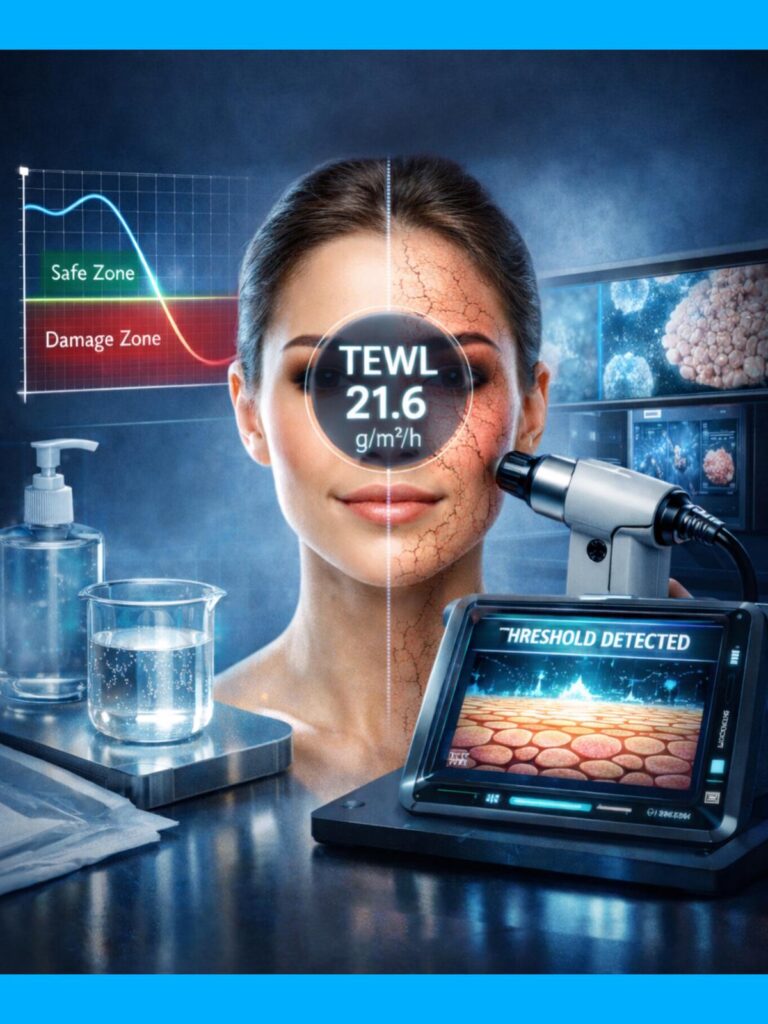
The TEWL Auditor
How to find your exact cleanser damage threshold using the TEWL Auditor
For years, you might have been scrubbing it with harsh detergents that strip away the protective coating, wondering why you’re suddenly getting wet in the rain. In the world of skincare, we have been conditioned to believe that a "squeaky clean" face is the goal.
In reality, that squeak is an alarm bell—the sound of your skin’s biological shield, the Stratum Corneum, being stripped of its essential defenses. To fix skin that feels tight, itchy, or perpetually dry, we must look past the bubbles and marketing and learn to think like a Barrier Health Auditor.
The concept of a "damage threshold" is simple: it is the breaking point where your cleanser stops being a tool for hygiene and starts being a weapon of destruction. Your skin barrier is a complex "bricks and mortar" structure.
The "bricks" are your skin cells, and the "mortar" is a rich blend of lipids—ceramides, cholesterol, and fatty acids. When you wash your face, you use surfactants to remove "bad" oils like pollution and excess grease.
However, if your cleanser is too aggressive, it can’t tell the difference between the grime you want to lose and the "mortar" you need to keep. Once that mortar is washed away, you have crossed your damage threshold. Measuring this isn't just for scientists; it is a vital diagnostic for anyone struggling with redness, an "orange peel" texture, or that stinging sensation when you apply your favorite cream.
Micro-Glossary: Stratum Corneum
The outermost layer of the epidermis, consisting of dead cells (corneocytes) that form the primary physical barrier against the environment.
Table of Contents
The information provided in this article is for educational purposes only and does not constitute professional medical advice, diagnosis, or treatment. Always seek the advice of a dermatologist or other qualified healthcare provider with any questions you may have regarding a skin condition or skincare regimen.
Why you need to measure your cleanser damage threshold
You must measure your "cleanser damage threshold" because the common "squeaky clean" sensation is actually a physical symptom of a Transepidermal Water Loss (TEWL) spike, signaling that your natural protective oils have been stripped away.
Imagine a well-oiled wooden floor; your feet glide over it easily. If you scrub that floor with a harsh chemical until it "squeaks," you haven't just cleaned it—you’ve stripped the finish, leaving the wood raw and vulnerable to warping. Your skin reacts the same way.
That "squeak" is caused by increased friction because the lubricating oils that should be there to keep your skin supple have been rinsed down the drain. Without these lipids, your skin becomes a "leaky bucket," unable to hold onto the moisture it needs to stay healthy.
The "tight feeling" we often feel after washing is a warning sign that we’ve been taught to ignore. In clinical terms, that tightness is actually an acute physical injury. It is the feeling of your skin cells literally shrinking.
As the water inside your skin evaporates into the air—a process called a TEWL spike—your skin pulls tight like a piece of drying leather. If you ignore this threshold, you are trapped in a "wash and wound" cycle. Every morning and night, you create tiny cracks in your barrier, leading to chronic inflammation, or "inflammaging." This makes your skin more sensitive to everything from dust to perfume and can even lead to premature fine lines.
By finding the exact moment your cleanser crosses the line, we can switch your focus to corneotherapy—the practice of protecting the Stratum Corneum so that the deeper layers of your skin can finally heal.
Micro-Glossary: Transepidermal Water Loss (TEWL)
The objective measurement of the amount of water that evaporates through the skin's surface to the outside environment.
What is the TEWL Auditor (and how does it stop skin damage)?
The TEWL Auditor is a systematic, at-home diagnostic protocol designed to isolate your facial cleanser as a single variable to measure its impact on your skin’s moisture retention.
Most people try to fix skin issues by adding more products—serums, oils, and masks. The Auditor does the opposite: it simplifies everything to see how your skin reacts to its most basic daily challenge: the wash. It turns you from a person who just "buys products" into a "skin scientist" who understands their own biology.
The core of this test is measuring Transepidermal Water Loss (TEWL). Think of TEWL as "invisible evaporation." Even as you read this, water is moving from the deep, hydrated layers of your body, through the skin, and out into the atmosphere.
A healthy barrier acts like a high-quality plastic wrap, keeping that water where it belongs. But when a cleanser is too harsh—perhaps because it has a high pH or uses "strip-everything" surfactants like Sodium Lauryl Sulfate (SLS)—it pokes microscopic holes in that wrap.
The TEWL Auditor tracks how fast water is "leaking" out. If your face feels tight within minutes of washing, your "moisture drop-off rate" is too high. This means your cleanser has stolen your Natural Moisturizing Factors (NMFs)—the tiny magnets your skin used to hold onto water.
The Auditor stops damage by giving you the proof you need to fire a "toxic" cleanser before it causes permanent structural failure.
Micro-Glossary: Natural Moisturizing Factors (NMFs)
A collection of water-soluble compounds (like amino acids and lactic acid) found within corneocytes that help the skin hold onto water.
Identify when to run the TEWL Auditor to find your cleanser damage threshold
You should run the TEWL Auditor if you experience persistent dryness despite heavy moisturizing, as this suggests your cleansing step is creating microscopic cracks that no cream can fill.
Many people find themselves in the "moisturizer trap"—applying thicker and thicker creams to skin that still feels dry and tight. This is like trying to heat a house while all the windows are wide open.
No matter how high you turn up the heat (the moisturizer), the warmth (the hydration) just escapes. Until you "close the windows" by fixing your cleansing step, you are wasting your money on expensive products that only provide a temporary band-aid.
A healthy skin barrier is resilient. It should feel flexible, soft, and comfortable within 10 to 15 minutes of air-drying, even without any lotion.
If you feel like you have to race to your vanity to put on moisturizer because your face feels like it might crack, you have failed the "Barrier Baseline." Use the Decision Matrix below to see where your skin currently stands on the danger scale.
| Symptom | Severity | Action |
|---|---|---|
| Skin feels tight < 2 minutes post-wash | Critical | Stop your cleanser immediately. Your skin is "bleeding" moisture. Use only lukewarm water for 48 hours. |
| Visible flaking or "orange peel" texture | High | Run the TEWL Auditor. You likely need a non-foaming, pH-balanced "milk" cleanser. |
| Stinging when applying regular serums | Moderate | Run the TEWL Auditor. Your "shield" is thin; reduce "active" ingredients like Retinol. |
| Skin feels comfortable > 15 mins post-wash | Healthy | You are below your damage threshold. Check again in 6 months or when seasons change. |
Micro-Glossary: Corneotherapy
A skincare methodology that focuses on the repair and maintenance of the skin barrier (Stratum Corneum) as the primary way to improve overall skin health.
How to run the TEWL Auditor test to measure your exact damage threshold
Running the TEWL Auditor requires a two-night protocol to compare your skin's natural "barrier baseline" against the chemical impact of your specific facial cleanser.
This separation is crucial because you can’t know how much your cleanser is hurting you until you see how your skin behaves when it's left alone. It’s the difference between a "control group" and a "test group" in a laboratory.
Micro-Glossary: Damage Delta
The measured difference or gap between your skin’s natural moisture baseline and the moisture loss triggered by a product.
Establish your natural barrier baseline with a water-only wash
Establishing a "natural barrier baseline" requires a 15-minute wait-period after a water-only wash to observe your skin's intrinsic oil production without interference. On the first night of the test, put your cleanser away.
Splash your face with lukewarm water only. Avoid using a washcloth, as the rubbing action is a form of mechanical exfoliation that can mask the results.
Gently pat your face dry with a soft towel and set a timer for 15 minutes. During this time, resist the urge to apply any toner, serum, or cream.
Lambers et al. found that healthy skin sits at a pH of about 4.7 (slightly acidic). While tap water (which is usually neutral or pH 7.0) isn't a perfect "no-effect" control, it is the safest way to see your skin's "naked" state.
After 15 minutes, check in with your face. Is it comfortable? Do you see a little bit of natural shine returning to your forehead or nose? This is your "Baseline." If your skin feels okay here but tight on Night Two, your cleanser is the culprit.
Micro-Glossary: Acid Mantle
A very thin, slightly acidic film on the surface of human skin acting as a barrier to bacteria, viruses, and other potential contaminants.
Test your facial cleanser to detect sudden moisture loss
Testing your facial cleanser reveals the "damage delta," or the specific amount of moisture loss caused by your product compared to your baseline.
On the second night, use your regular face wash exactly as you normally do. Rinse it off, pat dry, and again, set that 15-minute timer without applying any other products.
The International Journal of Cosmetic Science explains that the pH and the "bubbles" (surfactants) in your wash are the biggest factors in barrier health.
Many traditional soaps have a pH of 10—which is nearly as alkaline as baking soda. This is a shock to skin that prefers a pH of 5.5.
A "damage delta" is the gap between how your skin felt on Night One versus Night Two. If your skin feels significantly tighter or looks dull and "flat" on Night Two, it means your cleanser is "intercalating"—or forcing its way—into your skin's lipid layers, causing them to collapse and let water rush out.
Micro-Glossary: Intercalation
The process by which surfactant molecules wedge themselves into the skin's lipid bilayers, disrupting the organized "bricks and mortar" structure.
Fix the skincare mistakes that push you past your cleanser damage threshold
Fixing a breached barrier requires immediate cessation of all aggressive surfactants and "active" exfoliants to provide the Stratum Corneum with a stable environment for self-repair.
When your barrier is "leaking," your skin is in a state of emergency. It’s like a construction site that has been hit by a storm; you can't keep building (using anti-aging products) until you fix the foundation and dry everything out.
Micro-Glossary: Inflammaging
The theory that chronic, low-grade inflammation (often caused by barrier damage) accelerates the aging process of the skin.
Stop using active exfoliants to halt immediate moisture loss
You must immediately halt the use of chemical exfoliants when the TEWL Auditor detects a threshold breach to prevent "desquamation failure," where the skin sheds too rapidly for the barrier to close.
Desquamation is just the scientific word for your skin's natural shedding process. When you use acids like AHAs or BHAs on a broken barrier, you are essentially "picking the scab." You are forcing skin cells to shed before the new cells underneath are ready to protect you.
A study in the British Journal of Dermatology showed that after using an 8% AHA formula, the skin was much more vulnerable to damage from even basic soaps. In fact, the "leakiness" (TEWL) was still visible 48 hours later.
This proves that if your barrier is already failing the Auditor test, continuing to exfoliate is like pouring gas on a fire. Stopping these "actives" gives your skin the breathing room it needs to finish its own repair work.
Micro-Glossary: Desquamation
The natural process of shedding the outermost layer of skin cells in a controlled, invisible manner.
Apply occlusive balms to physically shield your broken skin barrier
Applying occlusive agents creates a "synthetic acid mantle" that physically halts water evaporation, giving the skin’s internal lipid-producing machinery time to heal.
Most people use "humectants" (like Hyaluronic Acid), which act like sponges to hold water. But if your barrier is broken, that sponge just dries out. You need an "occlusive"—a lid that seals the moisture in. Think of it as a temporary "second skin" while your real one heals.
Research shows that plain petrolatum (like Vaseline) at a concentration of just 5% can stop 98% of water loss.
Czarnowicki et al. even found that these balms don't just sit there; they actually signal your skin to start building its own ceramides again. This is why we call these balms "water-loss shields."
For three days after a barrier breach, skip the fancy serums and use a simple occlusive balm to give your Stratum Corneum a chance to rebuild its "mortar."
Micro-Glossary: Occlusive Agents
Ingredients (like Petrolatum or Mineral Oil) that form a physical film on the skin's surface to prevent moisture from escaping.
Choose safe face washes that stay below your cleanser damage threshold
Choosing a cleanser that stays below your damage threshold involves prioritizing "non-stripping" surfactants like Coco-Glucoside and ensuring the formula is pH-balanced to the skin's natural acidity (pH 4.5–5.5).
You want a product that removes the "daily grime" but leaves the "biological gold" (your lipids) behind.
When you look at a label, don't be fooled by words like "foaming" or "deep pore cleansing," which often just mean "harsh." Instead, look for ingredients that your skin recognizes as its own. Use the table below as your shopping guide.
| Cleanser Trait | High-Risk (Avoid) | Barrier-Safe (Choose) |
|---|---|---|
| The "Soap" Ingredient | Sodium Lauryl Sulfate (SLS) | Coco-Glucoside, Decyl Glucoside |
| The Acid Level | pH 8.0 - 10.0 (Like soap) | pH 4.5 - 5.5 (Like skin) |
| The Feel | Big bubbles, "Squeaky" clean | Creamy, milky, or low-lather |
| Extras | High Alcohol, Strong Fragrance | Ceramides, Glycerin, Panthenol |
| After-Feel | Matte, tight, "Pulled" | Soft, "Dewy," flexible |
The most important rule for your new cleanser is the "After-Feel." Your face should feel just as comfortable as it did on Night One of your test (the water-only night). If your face feels "matte" or "dry," the cleanser is stealing your youth-preserving oils.
Micro-Glossary: Surfactants
Short for "surface active agents"—compounds used in cleansers that break down oils and debris so they can be rinsed away with water.
The Barrier Integrity Checklist
Don't wait until your skin is red and peeling. Take this 5-point checklist into your bathroom tonight to audit your current routine.
- The 10-Minute Test: Can I wait 10 minutes after washing without feeling the "need" to apply moisturizer?
- The pH Check: Is my cleanser specifically formulated to be "pH balanced" or "acidic" (pH 5.5)?
- Surfactant Audit: Is the label free of harsh sulfates (like SLS or Sodium C14-16 Olefin Sulfonate)?
- The Mirror Test: Is my skin free of redness or that "tight, shiny" look immediately after patting dry?
- Product Absorption: Does my moisturizer actually make my skin feel better, or does it just sting and sit on top of dry patches?
Micro-Glossary: Barrier Integrity
The physical state of the skin barrier, specifically its ability to maintain structural soundness and keep environmental stressors out while retaining moisture.
Conclusion: From Cleaning to Auditing
Identifying your cleanser damage threshold using the TEWL Auditor is the critical first step in addressing chronic dehydration. By establishing a natural baseline and measuring the "damage delta" caused by your current products, you can pinpoint the specific triggers of barrier disruption. Restoring health to the Stratum Corneum requires immediately stopping aggressive surfactants and active exfoliants while shielding the skin with occlusive agents. Ultimately, replacing a "squeaky clean" mindset with a diagnostic, pH-balanced approach ensures that your daily cleansing routine supports, rather than destroys, your skin's protective lipid barrier.
Frequently Asked Questions (FAQs)
No. A washcloth provides mechanical exfoliation, which can cause its own form of barrier disruption. To get a true "naked" baseline of your skin’s oil production, use only your hands and lukewarm water.
Yes. Hard water has a high mineral content and a more alkaline pH, which can contribute to dryness. However, because you use the same water for both Night One (Baseline) and Night Two (Cleanser), the "Damage Delta" remains a valid measurement of the cleanser’s specific impact.
You should run the audit whenever you introduce a new cleanser, or if your skin condition changes significantly (e.g., during a change of seasons or moving to a different climate).
The Auditor works best when testing your primary surfactant step. If you usually double cleanse (oil followed by water-based), Night Two should include your full cleansing routine. If the audit fails, you may need to investigate which of the two products is pushing you past your threshold.
While pure oils do not usually cause a TEWL spike, many commercial oil cleansers contain emulsifiers that allow them to rinse off with water. If these emulsifiers are too aggressive, they can still strip your natural lipids and cause post-wash tightness.